Section
How Vocal Jazz Ensembles Work
Central guide to how adult vocal jazz ensembles function, covering voice parts, arrangements, direction, rehearsal routines and rhythm section teamwork.
By the District Songbook editorial teamPublished Revised Reading 8 minutes
5 pieces published in this section. Last revision .
Soprano to BassC3 to C6Four desks share every chart; each asks a different weight of a new voice.Voice parts
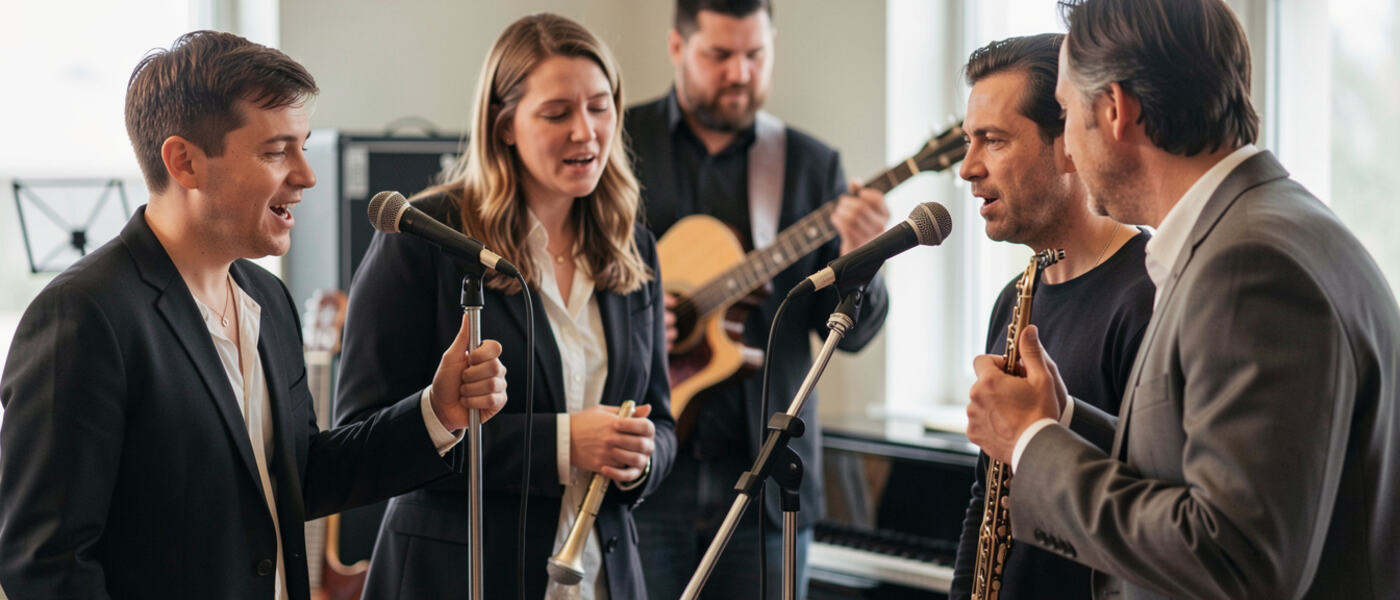
An ensemble works when each singer holds a part, hears the other parts and follows one set of gestures. You will learn how sections are built, how direction and placement shape the sound, and how rehearsals turn written lines into blended music.
You do not need to read notation fluently to understand the system. If you can find your starting note, watch for tempo and listen to the voices beside you, you already take part in the three decisions every choir makes: how many parts to sing, who guides the time and tone, and where each singer stands to hear best.
What holds an ensemble together
A choir, also called a chorale or chorus, from a Latin word for a dance in a circle, is a musical ensemble of singers. Choral music is the music written for that ensemble to perform, which is another way of saying the music performed by the singers themselves. Choirs may sing music from the classical repertoire, which spans from the medieval era to the present, or they may sing popular repertoire. Most choirs are led by a conductor who leads the performance with arm, hand and facial gestures. The word choir is often applied to groups tied to a church, whether or not they stand in the quire, while a chorus more often performs in theatres or concert halls, but the distinction is not rigid.
Why four parts became the normal starting point
Most often, a choir has four sections meant to sing in four-part harmony. An adult mixed choir usually follows that plan with soprano, alto, tenor and bass voices, often shortened to SATB. You can hear why the plan lasts. The outer voices give shape on top and bottom, the inner voices fill the chord, and a newcomer can learn one line while leaning on the other three. To understand how those lines behave in close harmony, voice parts and harmony sets out what each section carries. There is no limit to the number of possible parts as long as a singer is available to sing the part, so four is a habit, not a ceiling.
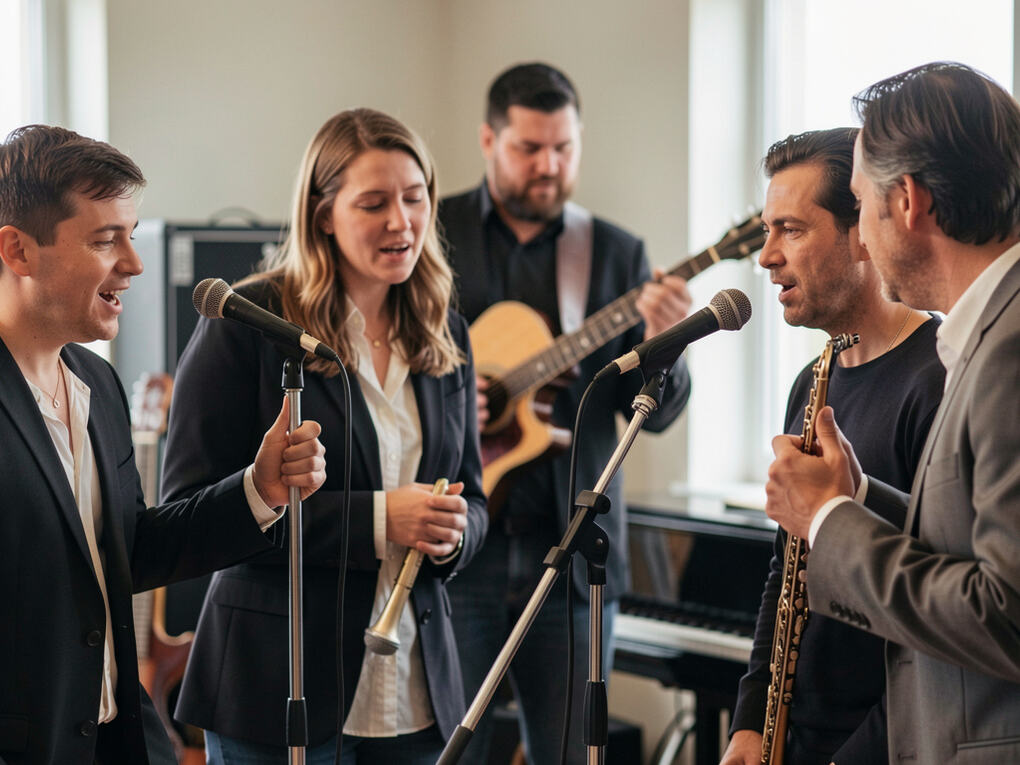
When three parts or eight parts make sense
Other than four, the most common numbers of parts are three, five, six and eight. A small adult group with few men may sing SAB, for soprano, alto and baritone, so a few low voices cover both tenor and bass work in one line, and altos sometimes help with the tenor line. A larger group may divide one or more voices in two, as in SSAATTBB where each voice splits, or SATBSATB where the choir divides into two semi-independent four-part choirs. Occasionally a baritone voice appears as well, as in SATBarB, often sung by higher basses. At the far edge are pieces such as the 40-part motet Spem in alium by Thomas Tallis, written for eight choirs of five parts each, and the Stabat Mater by Krzysztof Penderecki, written for three choirs of 16 voices each, a total of 48 parts.
How does accompaniment change what you sing?
Choirs may sing without instruments or with a piano, an accordion, a pipe organ, a small ensemble or an orchestra. Singing without accompaniment is usually called a cappella singing, although the American Choral Directors Association discourages that use in favor of unaccompanied, because a cappella denotes singing in the chapel style and much unaccompanied music today is secular. Accompanying forces vary widely, from a single instrument, such as the piano or pipe organ, to a full orchestra of 70 to 100 musicians. For rehearsals, a piano or organ is often used even if a different instrumentation is planned for performance, or even if the choir is rehearsing unaccompanied music. With the current spread of electronic devices, small groups can use them with learning tracks for group rehearsal and private practice.
Choirs may sing without instruments or with a piano, an accordion, a pipe organ, a small ensemble or an orchestra.
District Songbook, How Vocal Jazz Ensembles Work
What does the conductor actually do?
Conducting is the art of directing a musical performance, such as a choral concert, by visible gestures with the hands, arms, face and head. The primary duties of the conductor are to unify performers, set the tempo, give clear preparations and beats for meter, and listen closely to shape the sound of the ensemble. For a plain statement of that role, you can read this broad overview of the choir and then come back to how it feels in the room. A conductor may or may not stand on a raised platform or use a baton. A baton gives greater visibility, but many choral conductors prefer hands alone for greater expressiveness, particularly with a smaller ensemble. In the 2010s, most conductors did not play an instrument while conducting, although leading while playing was common in earlier periods.
Why does the same person often choose, teach and direct?
In most choirs, the same individual acts as musical director, chorusmaster and conductor. The musical director decides repertoire and engages soloists and accompanists. The chorusmaster, also called a repetiteur, trains and rehearses the singers. The conductor directs the performance. Those roles may divide, especially when a choir joins other forces, for example in opera. The link between those jobs and the players beside the singers is practical, and directors and rhythm sections explains how support roles divide the work. Conductors also choose works to perform, study scores, adjust tempo, repetition of sections and assignment of vocal solos, work out an interpretation and relay that vision to singers. They may conduct an orchestra when a piece calls for choir and orchestra, and they may handle scheduling of rehearsals, planning of a concert season, auditions and promotion of the ensemble in the media.
Where do singers stand and why does it matter?
There are several schools of thought about placement, and it is the conductor who decides where voice types stand. In symphonic choirs, it is common, though by no means universal, to order the choir behind the orchestra from highest to lowest voices from left to right, matching the typical string layout. In a cappella or piano-accompanied settings it is not unusual for men to stand in the back and women in front. Some conductors place basses behind sopranos so the outer voices can tune to each other. More experienced choirs may mix all voices. Sometimes singers of the same voice stand in pairs or groups of three. Supporters of mixed placement say each singer hears and tunes to other parts more easily, although it requires more independence. Critics say that the method loses spatial separation of lines, which helps the audience, and removes sectional resonance, which lowers effective volume.
Which type of choir fits an adult voice?
One main classification is by gender and age, because those factors have long shaped sound and repertoire. A male choir of men and boys uses the same SATB voicing as a mixed choir, but boys sing the upper part, often called trebles or boy sopranos, and men sing alto in falsetto, also known as countertenors. A men's chorus of adult men with low voices only usually has two tenors, baritone and bass, often shortened to TTBB, or ATBB if the upper part sings falsetto in alto range. A women's choir of adult women with high voices only usually has soprano and alto voices, two parts in each, often shortened to SSAA, or soprano one, soprano two and alto, shortened to SSA. Choirs are also grouped by institution, including church choirs, chorale or Kantorei for sacred Christian music, collegiate and university choirs, community choirs, professional choirs either independent or state-supported, school choirs, signing choirs, integrated signing and singing choirs, cambiata choirs and virtual choirs. By repertoire, there are Bach choirs, barbershop groups, gospel choirs, show choirs in which members sing and dance, symphonic choirs and vocal jazz choirs. To place those labels on a local map, singing in Washington shows where adults join and perform.
How do rehearsals turn separate parts into one sound?
Communication is typically nonverbal during performance. That rule holds strictly in art music, while in jazz big bands or large pop ensembles there may be occasional spoken instructions. In rehearsal, the conductor often gives verbal instructions, because the conductor also serves as artistic director who shapes the interpretation. Many choirs perform in churches, opera houses, schools or village halls. In some cases choirs join to form a single massed choir for a special concert, presenting a series of songs or musical works to celebrate and entertain others. In typical oratorios and masses from the 18th century to the 21st century, the words chorus or choir imply more than one singer per part, unlike the quartet of soloists also featured in those works. A choir can also name a subset inside a larger ensemble, as in the woodwind choir of an orchestra, or different choirs of voices or instruments in a polychoral work.
Listen once for blend instead of volume at your next rehearsal, keep your eyes on the beat through one full phrase, and ask the singer beside you after the break which cue helped the most.
In this section
Directors and Rhythm Sections in Choirs
When an adult vocal group finds its sound, you can hear the people around the singers at work.
7 minRead the article
How Singers Read Charts and Learn Parts
Reading a chart in an adult vocal jazz group is a practical skill.
8 minRead the article
Understanding Voice Parts and Jazz Harmony
If you sing in an adult jazz ensemble in Washington, part names tell you where you will sit in the chord and how much weight each line needs.
8 minRead the article
How Jazz Choirs Are Founded and Led
If you want to start an adult vocal jazz group in Washington, you help decide how the music will hold together before anyone sings the first chord.
6 minRead the article
What Defines an Adult Vocal Jazz Choir
An adult vocal jazz choir puts the voice where an instrument would sit.
6 minRead the article