What Defines an Adult Vocal Jazz Choir
Explains what defines an adult vocal jazz choir, how voices blend with a rhythm section, and how rehearsals build blend, timing and improvisation skills.
By the District Songbook editorial teamPublished Revised Reading 7 minutes
An adult vocal jazz choir puts the voice where an instrument would sit. You sing in a small group of voices with piano, bass, drums and guitar behind you, and you learn to shape rhythm, tone and phrasing the way a horn player might. If you are curious about joining in Washington, this guide explains the format, the blend, the rhythm players and how a rehearsal moves.
What makes a vocal jazz choir different
Vocal jazz is a genre within jazz where the voice is used as an instrument. It began in the early twentieth century, with roots in blues and ragtime that can be traced back to the New Orleans jazz tradition. That history still shapes the sound you hear in a choir room. Expect syncopated rhythms, room for improvisation, and pitch and tone that bend away from a straight classical line. A vocal jazz ensemble brings together multiple voices alongside instrumental accompaniment, so you are never singing alone in a void. You learn your line, you listen across the group, and you fit your timing and color into a shared groove.1
How is the voice used as an instrument?
In this style, the voice copies what instruments do. Jazz is characterized by syncopated rhythms, improvisation and distinctive handling of tonality and pitch, and singers carry those traits in the melody. You hold back a beat, you slide into a note, you shorten a phrase, you answer another section. The approach is close to speech on some songs and more stretched and playful on others. For background on the history of vocal jazz, you can read how those habits connect blues, early jazz and later group singing. In rehearsal, think less about a pure sustained tone and more about timing, attack and release.
Where did this singing come from?
Jazz singing originates from enslaved African Americans who sang field hollers and work songs. Those songs gave people a way to voice their feelings under oppression, to pass the time and to coordinate their work. Musically they used call and response, repetitive phrasing and improvisation, and those devices remain foundational in jazz. Spirituals sung in churches, along with minstrel shows and vaudeville, also helped form the basis for jazz music. Jazz grew in popularity in the early twentieth century with its roots in blues. When you trade phrases with another section or repeat a riff to lock it in, you are practicing a very old method of musical conversation.2
Who shaped the sound you hear now?
Louis Armstrong is often cited as a major contributor to the rise of vocal jazz, starting in the late 1920s. His 1926 recording of "Heebie Jeebies" is often cited as the first modern song to employ scatting, a vocal improvisation technique. In the 1940s jazz moved into the bop era. Notable singers of this period were Ella Fitzgerald, Sarah Vaughan, Billie Holiday and Dinah Washington, who had all previously sung with big bands and developed solo careers. With the rise of the more relaxed cool jazz in the 1950s, singers followed the same laid-back approach. That period brought Peggy Lee, June Christy, Chris Connor, Helen Merrill, Chet Baker, Carmen McRae, Joe Williams and Ray Charles. A newcomer does not need to copy them, but listening helps you hear phrasing choices.
Louis Armstrong is often cited as a major contributor to the rise of vocal jazz, starting in the late 1920s.
District Songbook, How Vocal Jazz Ensembles Work
What does the rhythm section actually do?
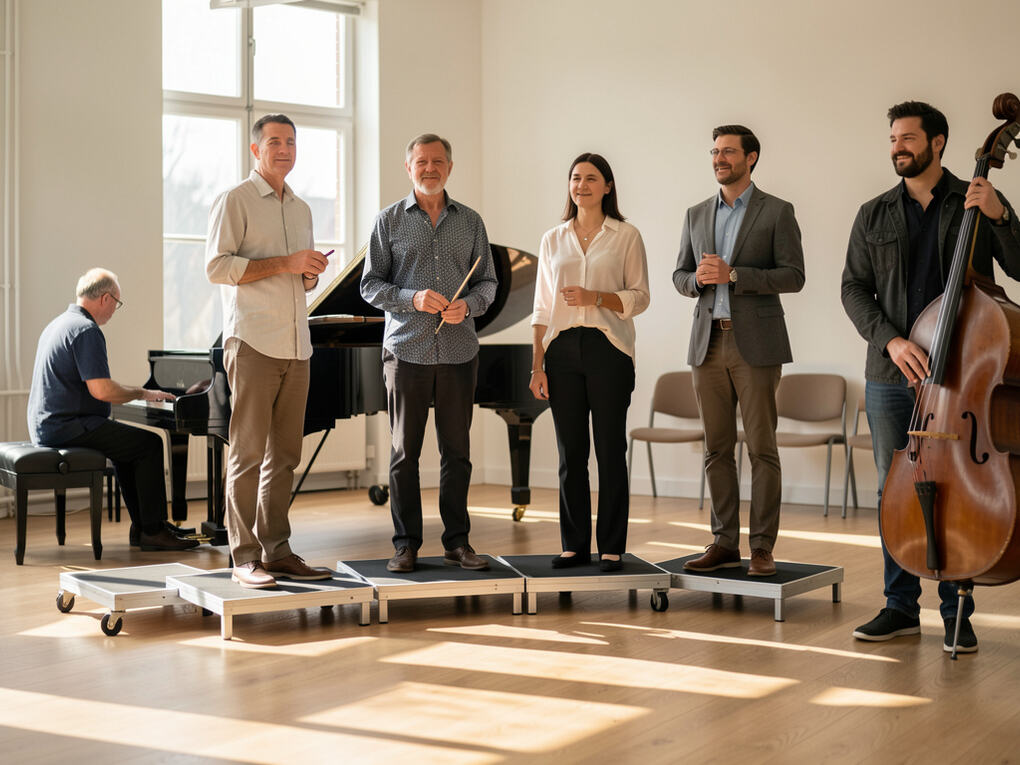
Most jazz singers work with a rhythm section of piano, bass, drums and guitar, and sometimes with vocal percussion. In a choir setting those players are your framework. Piano sets harmony and voicing, bass outlines movement and keeps time honest, drums shape swing and accents, and guitar adds color and rhythmic lift. You can learn more about rhythm section roles before you attend a first session. Your job is to stay inside that frame while keeping your line alive. Watch the count, catch the breath before a syncopated entrance, and let the drums and bass teach you where the pocket sits instead of pushing ahead of it.3
How do voices blend without sounding classical?
Blend here does not mean smoothing every voice into one classical vowel. Vocal jazz uses techniques such as pitch bending, inflections, clear handling of consonants and soft releases of vowels. Compared with classical choral pedagogy there is less legato and less ornamental use of vibrato. Pronunciation stays more conversational and musical phrasing tends to be shorter than in choral singing. Read about voice parts and harmony to hear how sections stack without losing that speech-like clarity. Arrangements ask for flexibility and mixed register singing, and singers usually work in keys that sit in the middle to low registers, which helps the group sound warm and intelligible on a microphone.
What will you sing first?
Vocal jazz repertoire typically includes music from the Great American Songbook, and popular music arrangements are often made for vocal jazz ensembles. That means you are likely to meet familiar tunes with clear forms, steady harmonic movement and room to play with time. A director may hand you a lead sheet style chart or a written arrangement with harmony parts and rhythmic hits. Learn the melody straight first, then add inflection. Speak the lyrics once under your breath to find the natural stress, then sing them on pitch with short, connected phrasing. Leave scat and extra ornament for later, after the notes and entrances feel secure.
How does a rehearsal move from start to song?
Rehearsal flow follows the music, not a fixed ritual. You can preview how ensembles rehearse together to picture the room. Time is usually spent tuning entrances, matching vowels on held chords, cleaning consonants on fast passages and practicing releases so that chords close together. Microphone technique is a big part of vocal jazz singing, because it lets vocalists amplify the voice on certain phrases, so you may practice stepping closer or pulling back and keeping dynamic shifts small and controlled. Work songs taught singers to coordinate labor through rhythm, and a modern rehearsal uses the same idea. Count, breathe together, answer the call, repeat the tricky bar until the group feels it as one motion.
Do you need to scat on your first night?
No. Scat singing means vocal improvisation where vocalists imitate the tone and rhythm of instrumentalists, and it takes time to feel natural. On a first night, listening is more useful than inventing syllables. Notice how experienced singers bend pitch into a note, inflect a word for meaning, or soften the end of a vowel so the chord rings. Notice the shorter phrasing and the conversational diction that keeps text clear. If the group tries a simple improvised passage, you can start with two or three notes in rhythm, leave space, then stop. Space counts as phrasing, and restraint helps you stay with piano, bass, drums and guitar.
What should you listen for before you join?
Listen for balance between voices and instruments, not volume. A healthy group sound keeps text intelligible, keeps vibrato modest, and lets syncopation stay relaxed rather than rushed. Listen for mixed voices sitting comfortably in the middle-to-low range, for consonants that mark rhythm without popping through the microphone, and for soft vowel releases that let harmony settle. Ask to hear a Songbook tune and a popular arrangement side by side, since both belong in this repertoire. Pick one phrase from a recording you enjoy, learn it by ear, and bring that careful listening to your first rehearsal.